Our research
Protein regulation and function at proteome scale
We study proteome dynamics: how cells control the levels of their proteins as they adapt to changes in their environment. We also use these dynamics to uncover the functions of the many poorly characterised proteins in our cells. Working at proteome scale, we combine quantitative proteomics with computational biology and machine learning.
We are part of the Discovery Research Platform for Hidden Cell Biology at the University of Edinburgh.
How cells control protein levels
In living cells, proteins are continuously synthesised and degraded, and the balance between these two processes determines how much of each protein a cell contains. Cells adjust this balance as they grow, divide and respond to stress, and its disruption contributes to diseases such as cancer and neurodegeneration. This balance is governed by extensive regulatory networks, yet which regulator acts on which protein remains largely unknown.
Human cells contain hundreds of E3 ubiquitin ligases, which mark specific proteins for degradation, yet the targets of most have not been identified. Next-generation drugs such as PROTACs harness the same enzymes to eliminate disease-causing proteins, but can also affect proteins other than their intended targets.
We develop proteomic methods that measure the synthesis and degradation of thousands of proteins at once. Our DIA-pulse-SILAC workflow, for instance, shows how the degradation rate of each protein changes when a regulator is inhibited or a drug is added. We apply these methods to map the targets of degradation regulators and degrader drugs, to understand how cells control their proteome and to guide the development of degrader therapies.
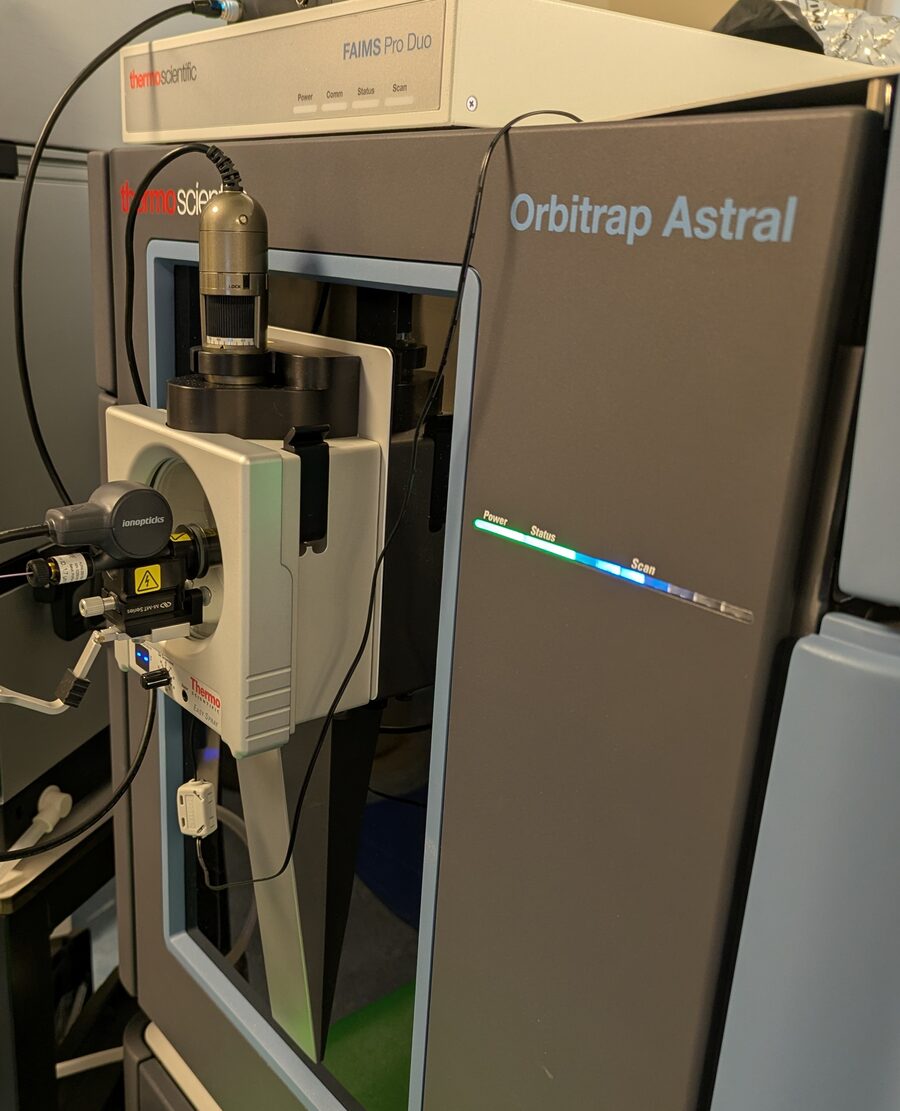
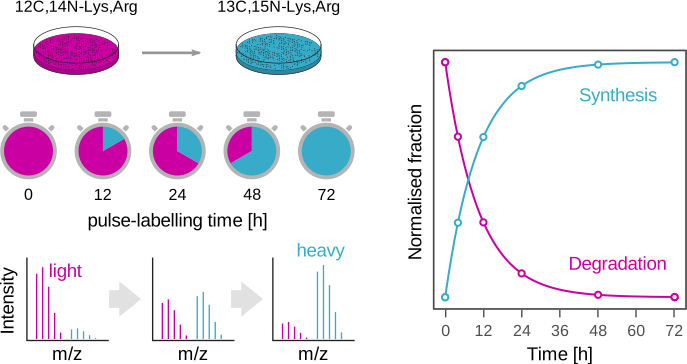
The Orbitrap Astral mass spectrometer and the principle of pulse-SILAC. After cells are switched to medium containing heavy isotope-labelled amino acids, newly synthesised proteins are heavy and pre-existing proteins remain light. Following both over time yields rates of synthesis and degradation (Munro et al., Proteomics).
Predicting protein function
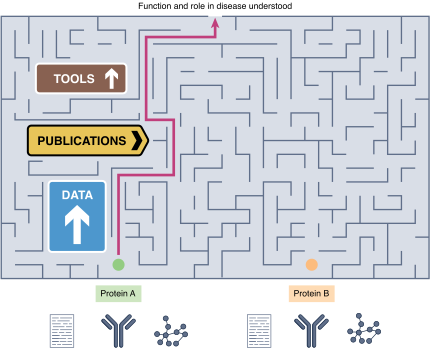
Proteome dynamics also serves as a powerful tool for functional discovery. Many proteins, in humans and other organisms, have no known biological function, even though some are essential for cell proliferation or linked to disease. Proteins that act together, for example in the same complex or pathway, show coordinated changes in abundance when cells are perturbed. By measuring how protein levels vary across hundreds to thousands of conditions, we detect this covariation, link uncharacterised proteins to partners of known function and infer their likely roles.
We combine these measurements into covariation maps and share them as open resources, such as ProteomeHD for the human proteome. We have extended this approach to yeast and to the prediction of human protein complexes.
Our funders
We are grateful for the support of our funders.